- Call Us: +90 (532) 266 27 16
- Opening Hours: Sunday - Friday, 09:00 - 21:00

What Causes Split Ends? Haircut and Care Options

Heat styling, coloring and lightening, friction, rough brushing and dryness can all contribute to breakage.
Once a hair strand has physically split, it cannot be permanently restored to its original structure. Hair care treatments can help the hair look smoother, softer and more controlled, but clearly split ends usually need to be trimmed.
For this reason, caring for split ends should focus on both removing damaged ends when needed and reducing the factors that contribute to new breakage.
What Are Split Ends?
The ends of the hair are usually the oldest part of each strand.
Over time, they are repeatedly exposed to:
Heat styling
Hair color
Lightening
Sun exposure
Friction
Brushing
Dryness
As the hair fiber becomes more worn, the end may begin to divide into two or more sections.
Breakage can also occur higher up the hair shaft, especially in hair that has been heavily processed or exposed to repeated mechanical stress.
What Causes Split Ends?
There is rarely just one cause.
Several factors often contribute at the same time.
Frequent Heat Styling
Straighteners, curling irons and very hot blow-drying can make the hair more vulnerable to dryness and breakage.
The risk may increase when high heat is:
Used frequently
Applied repeatedly to the same area
Used without heat protection
Reducing unnecessary heat can therefore be an important part of preventing further damage.
Hair Coloring and Lightening
Chemical color services can change the structure of the hair.
Repeated lightening, highlights, balayage or major color changes may leave the hair feeling:
Drier
Rougher
More difficult to detangle
More prone to breakage
This is why the condition of the hair should be considered alongside the desired color result.
Rough Brushing
Pulling a brush aggressively through tangled hair can create mechanical stress.
A more controlled approach is to:
Detangle the ends first
Move gradually toward the mid-lengths
Finish closer to the roots
Wet hair may also feel more vulnerable in some cases, so excessive pulling should be avoided.
Persistent Dryness
Dryness does not always mean the hair is split, but hair with reduced flexibility can be more prone to breakage.
Repeated heat styling, chemical processing and lack of appropriate conditioning can all contribute to a dry appearance.
Tight Hairstyles
Wearing the hair tightly in the same position every day can increase friction and pulling in certain areas.
Examples include:
Tight ponytails
Tight buns
Firm hair ties
Repeatedly securing the hair in exactly the same place
Changing hairstyles and reducing unnecessary tension may help limit mechanical breakage.
Are Split Ends the Same as Hair Loss?
No.
Split ends and breakage affect the hair shaft.
Hair loss involves hair being shed from the root.
Signs of breakage can include:
Shorter hairs at different lengths
Frayed or split ends
Uneven density through the lengths
Hair snapping before reaching the desired length
Ongoing or significant hair loss should be considered separately from cosmetic hair breakage.
Can Split Ends Be Repaired?
This is where the word “repair” needs to be used carefully.
A hair strand that has physically split cannot biologically fuse back together.
Hair care products and professional treatments may help:
Smooth the surface of the hair
Reduce the appearance of dryness
Improve manageability
Add softness and shine
Reduce factors that may contribute to future breakage
However, they do not permanently reconnect a split hair fiber.
For clearly damaged ends, trimming remains the most direct option.
Do Split Ends Need to Be Cut?
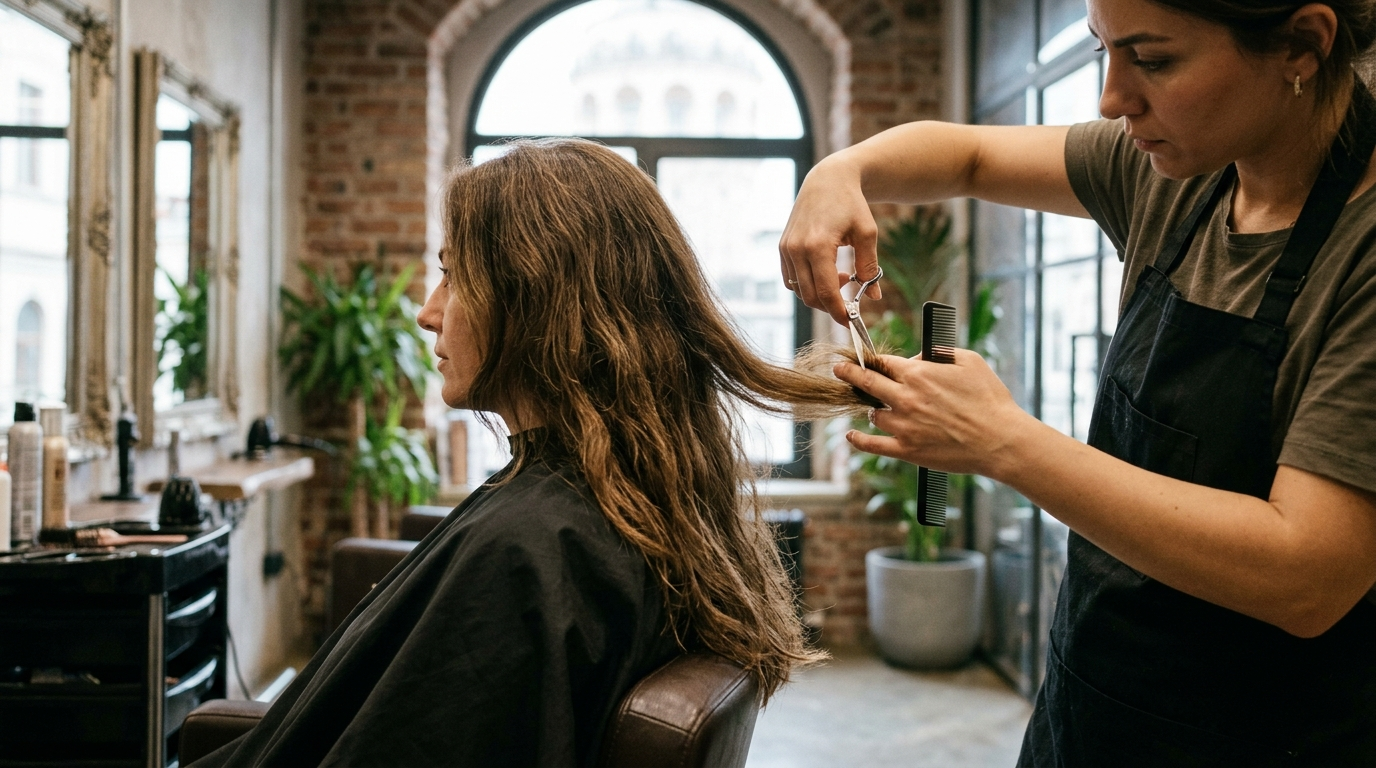
When the ends are visibly split or very thin, a haircut is usually the most effective way to remove the damaged section.
The amount that needs to be cut is different for everyone.
Some hair may only need a light trim, while more advanced breakage may extend further up the length.
The goal is not to remove as much hair as possible, but to take away the weakened area while keeping the desired shape and length in mind.
During a Haircut, the condition of the ends, current haircut and desired length can be considered together.
What Happens If Split Ends Are Not Cut?
A split end does not close on its own.
As the hair continues to be washed, brushed and styled, the damaged section may continue to fray or break higher up the strand.
This is why relying only on smoothing products for heavily split ends does not provide a permanent solution.
A more balanced approach may involve:
Removing clearly damaged ends
Supporting the remaining lengths with appropriate care
Adjusting daily habits that contribute to breakage
Haircuts and hair care do not need to be treated as competing solutions.
How Can Professional Hair Care Help With Breakage?
Professional Hair Care can be planned according to the current condition of the hair.
Depending on the needs of the hair, treatments may help:
Improve softness
Make detangling easier
Reduce the appearance of dryness
Add shine
Improve manageability
Help processed hair feel more controlled
However, no cosmetic treatment should be described as permanently reconnecting split ends.
The role of professional care is mainly to improve the condition, feel and appearance of the remaining hair.
Does Colored Hair Need Different Split-End Care?
Colored or lightened hair may need more careful maintenance because chemical processing can make the hair more vulnerable to dryness and breakage.
When planning care for processed hair, it can be useful to consider:
Frequency of heat styling
Elasticity
Dryness
Previous color services
Timing of future chemical services
If the hair is already significantly weakened, its condition should be considered before another major color or lightening service.
How Can You Help Prevent Split Ends at Home?
It may not be possible to prevent all breakage, but daily habits can reduce unnecessary stress on the hair.
Useful steps can include:
Avoiding aggressive brushing
Detangling from the ends upward
Limiting excessive heat
Using heat protection during styling
Avoiding very tight hairstyles
Using conditioner or masks suited to the hair type
Reducing friction when the hair is wet
Checking the ends regularly
The goal is not to use as many products as possible.
A simple routine that suits the condition of the hair is usually more useful than an overly complicated one.
How Often Should Split Ends Be Trimmed?
There is no universal schedule.
How often trimming may be needed depends on:
Hair length
Heat styling frequency
Coloring and lightening history
Hair texture
Daily care routine
Desired hairstyle
A trim can be considered when the ends begin to look noticeably frayed, thin or uneven.
Split-End Care at Luxus Hair Group
At Luxus Hair Group, haircut and hair care options can be planned according to the current condition of the hair.
Factors that may be considered include:
Dryness
Level of breakage
Current haircut
Desired length
Color history
Daily styling routine
When split ends are clearly visible, combining an appropriate trim with hair care may be more useful than relying on conditioning treatments alone.
Hair services are available at the Luxus Hair Group salons in Galata and Karaköy.
LUXUS Galata
Müeyyetzade, Galip Dede Cd. No: 97B
34425 Beyoğlu, Istanbul
LUXUS Karaköy
Arap Cami, Tersane Cd. No: 2
34421 Beyoğlu, Istanbul
Frequently Asked Questions About Split Ends
What causes split ends?
Heat styling, chemical processing, dryness, friction, rough brushing and tight hairstyles can all contribute to breakage.
Can split ends be repaired without cutting?
Hair care products can make the hair look smoother and feel softer, but they cannot permanently reconnect a physically split hair fiber.
Do split ends have to be cut?
Clearly split or frayed ends usually need to be trimmed if the goal is to remove the damaged section.
Do split ends stop hair growth?
Hair continues to grow from the root. However, repeated breakage at the ends can make it seem as though the hair is not gaining length.
Is colored hair more likely to develop split ends?
Repeated or intensive chemical processing can make the hair more vulnerable to dryness and breakage. The level of risk depends on the condition of the hair and the services performed.